
Finding the right cellar door Installer in NYC is not just about replacing a rusted hatch—it is about deciding whether an outward-opening door will improve access, protect the lower level, and stay on the right side of city rules. The problem is that a door that works on a private stairwell can become a hazard when clearance, drainage, snow, sidewalk traffic, or egress requirements are ignored. That is where owners lose money: leaks return, doors bind, and permits stall. The smart solution is to match the door swing to the property. In NYC, that means looking at whether the opening sits on private ground or city sidewalk, how the stairs drain, and whether the space below is storage, commercial, or legal living area.
Why the swing question gets more complicated in New York City
In New York City, “basement” and “cellar” are not interchangeable terms. HPD defines a basement as a story with at least half its height above curb level, while a cellar has more than half its height below curb level. That matters because legal use, occupancy, and egress expectations can change depending on what the space actually is, not what an owner informally calls it. A cellar door installation that seems simple on paper can trigger a different review once the City looks at the use of the space below grade.
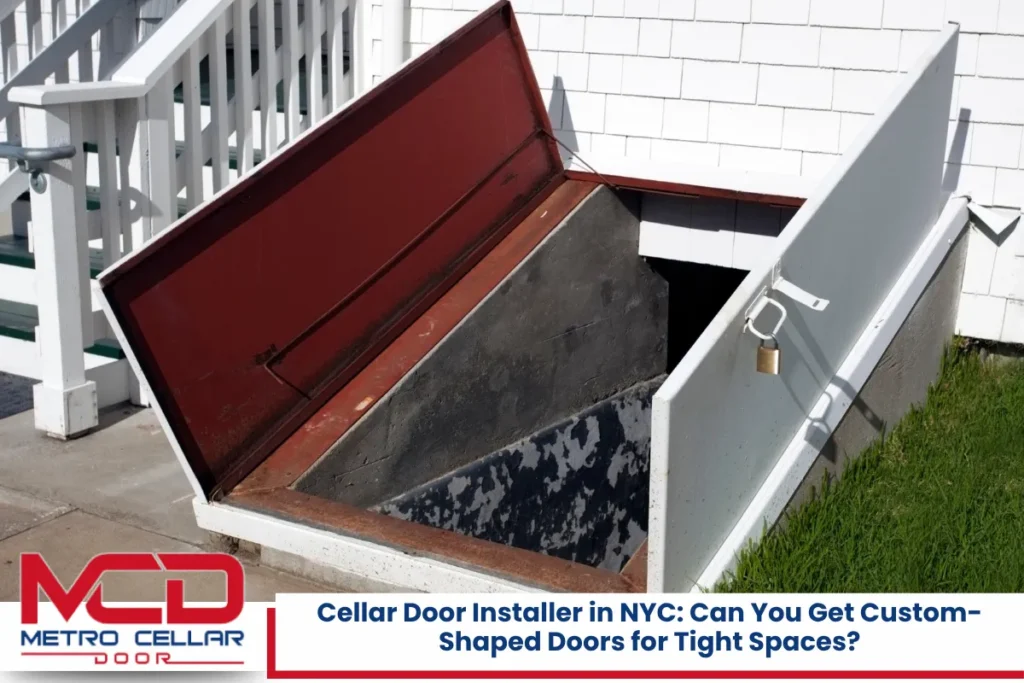
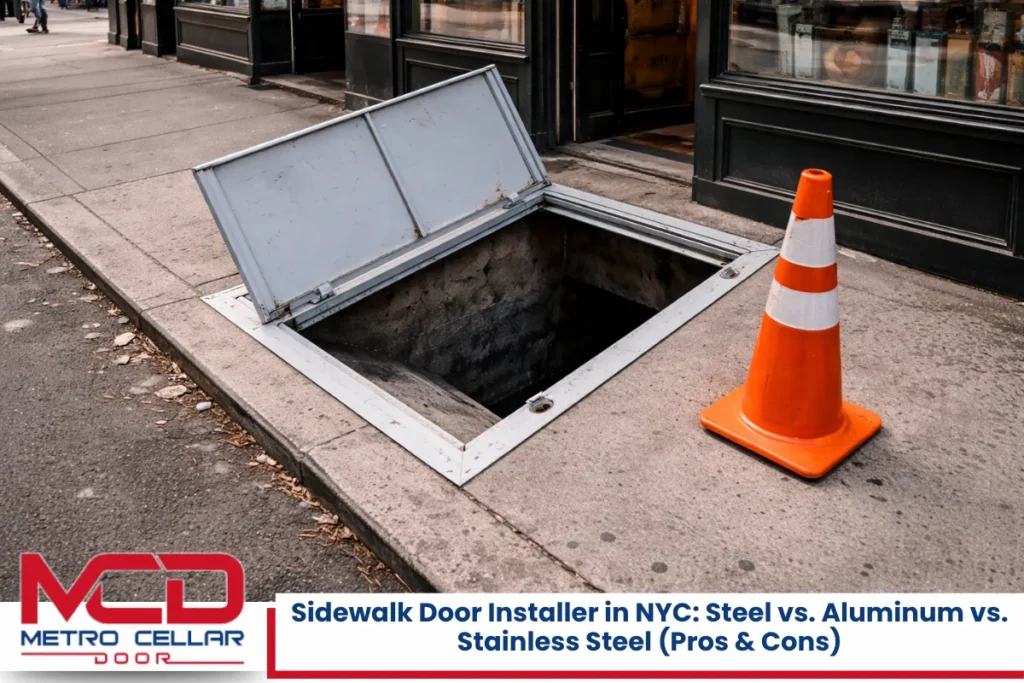
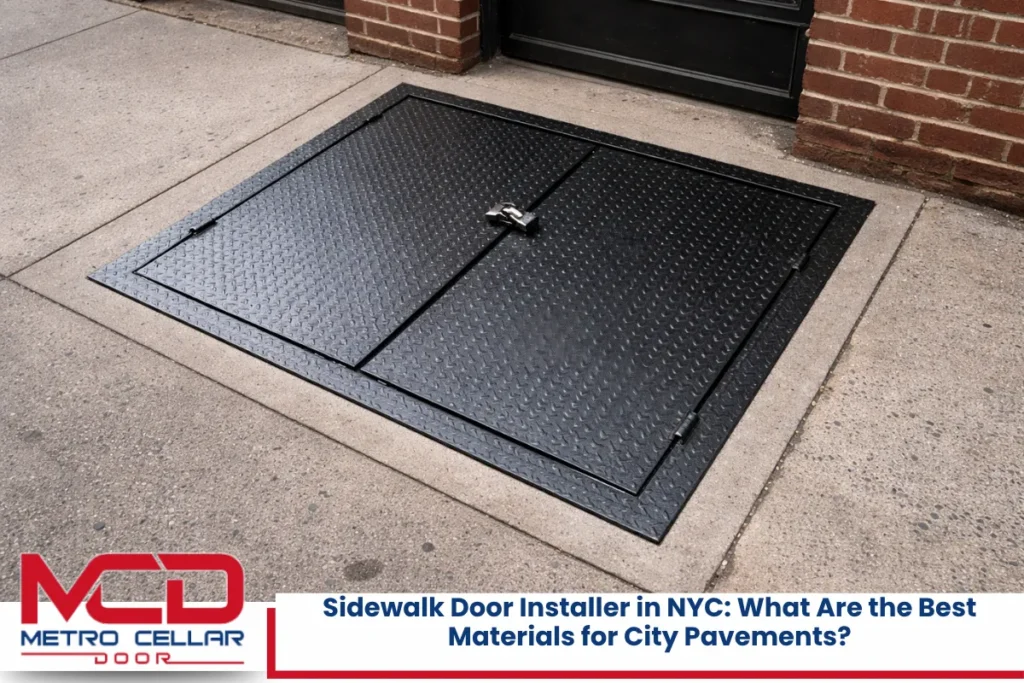
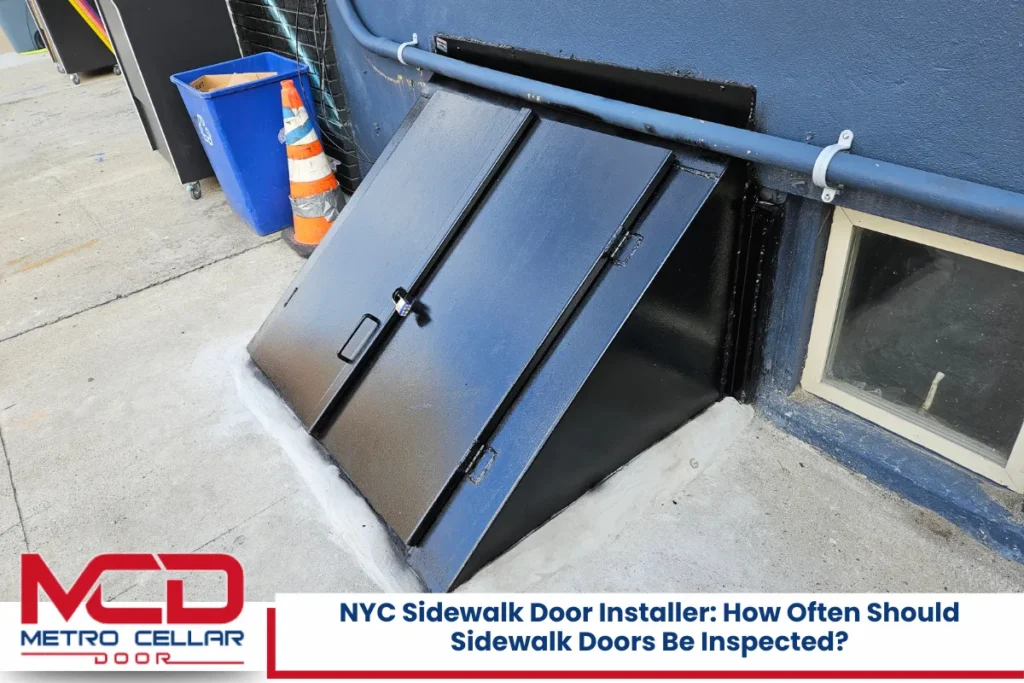
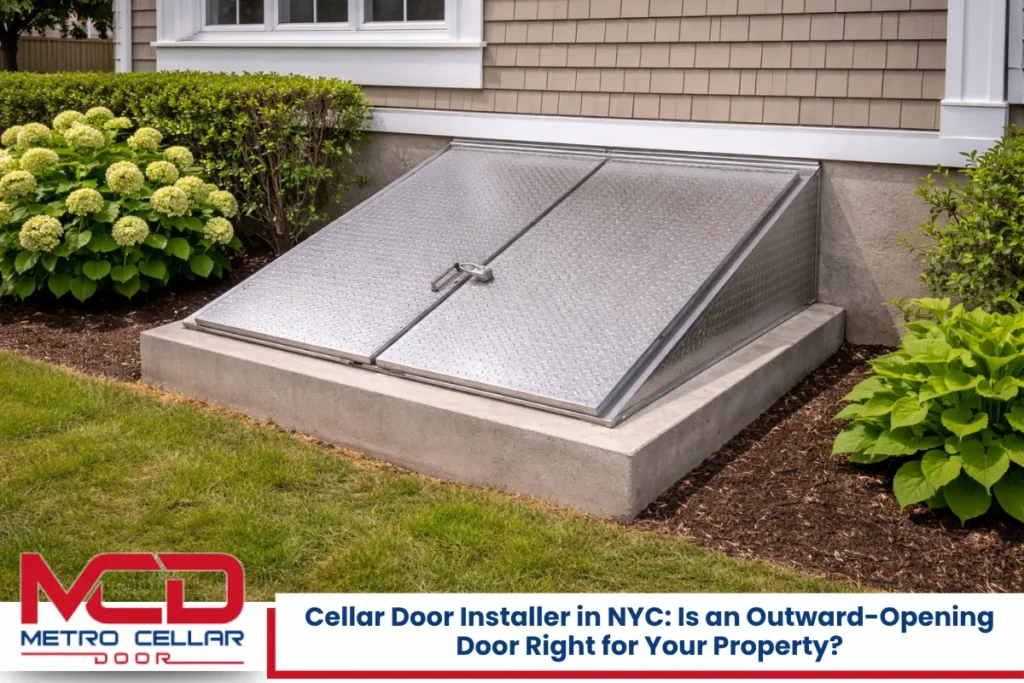
The phrase outward-opening door also covers two very different conditions. One is the classic sloped bulkhead or hatchway over a private exterior stair. The other is a flush sidewalk cellar door at grade in the public right-of-way. NYC DOT’s design guidelines for cellar doors on sidewalks require them to be flush, slip-resistant, placed against the building line outside the pedestrian access route, and generally limited in size. So the real answer is this: an outward-opening bulkhead can be excellent on private property, but a projecting door is usually the wrong concept for a sidewalk opening.
When an outward-opening cellar door earns its keep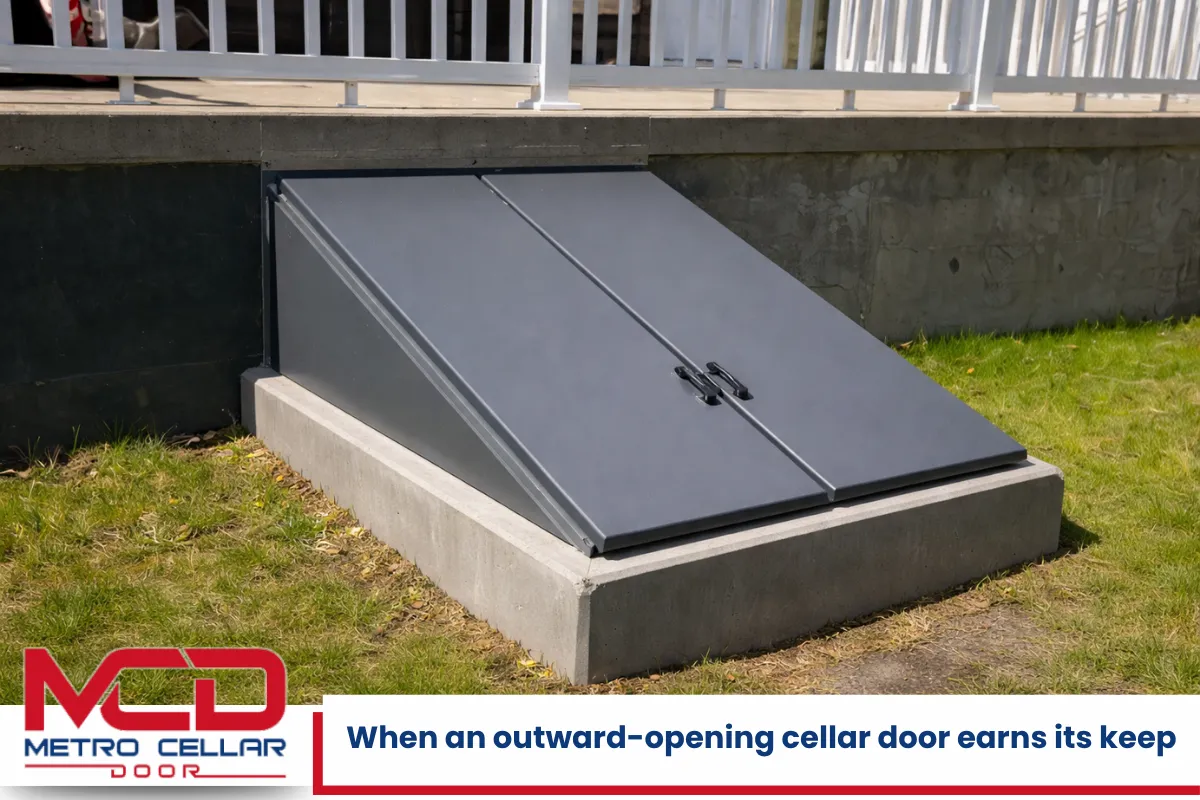
Better movement for people, tools, and large items
A well-designed outward-opening bulkhead gives you something interior stairs often do not: a wide, direct path to the lower level. That is one reason these cellar doors remain popular for storage areas, utility access, finished lower levels, and renovation work. Major manufacturers specifically market this style for moving large items in and out of basements, and the appeal is obvious in tight NYC homes where an inside stair may be narrow, steep, or buried behind finished rooms. For many owners, the right cellar door installer solves an access problem as much as a door problem.
More practical weather control than many owners expect
Outward-opening does not automatically mean leaky. In fact, the performance usually depends less on the swing and more on the assembly around it. Manufacturer installation guidance stresses that the frame must be plumb and square, the seams properly caulked, the masonry smooth and level, and roof runoff redirected away from the opening. It also notes that masonry beneath the door should sit higher than surrounding grade so water does not collect at the sill. That means a good cellar door installation is really part door work, part drainage work, and part masonry correction.
A strong fit for private areaways and side-yard stairwells
On private property, outward-opening cellar doors make sense when you have real swing clearance, a direct path to the stairs, and enough room for the leaves to open without hitting railings, walls, fences, condensers, or parked equipment. They are especially practical where you want to keep the stair opening clear while carrying boxes, mechanical parts, or appliances. Gas spring operators and similar lift assistance also make heavier steel doors easier and safer to handle once properly installed.
Where outward-opening doors can become the wrong answer
Public sidewalk conditions change everything
If the opening is on a City sidewalk, the job moves out of ordinary replacement thinking and into public-right-of-way rules. NYC311 states that a new sidewalk cellar door on a City sidewalk requires a revocable consent from DOT. DOT’s own guidelines require sidewalk cellar doors to be flush, slip-resistant, and against the building line outside the pedestrian access route. Separately, DOT’s vault-related rules require doors or gratings covering sidewalk openings or vault roofs to support heavy live loads, remain flush with the sidewalk, and stay out of front-entrance zones. So if your idea of outward-opening means doors that sit proud of the sidewalk or swing into foot traffic, that is a red flag.
Snow, ice, and neglected hardware can turn into safety issues
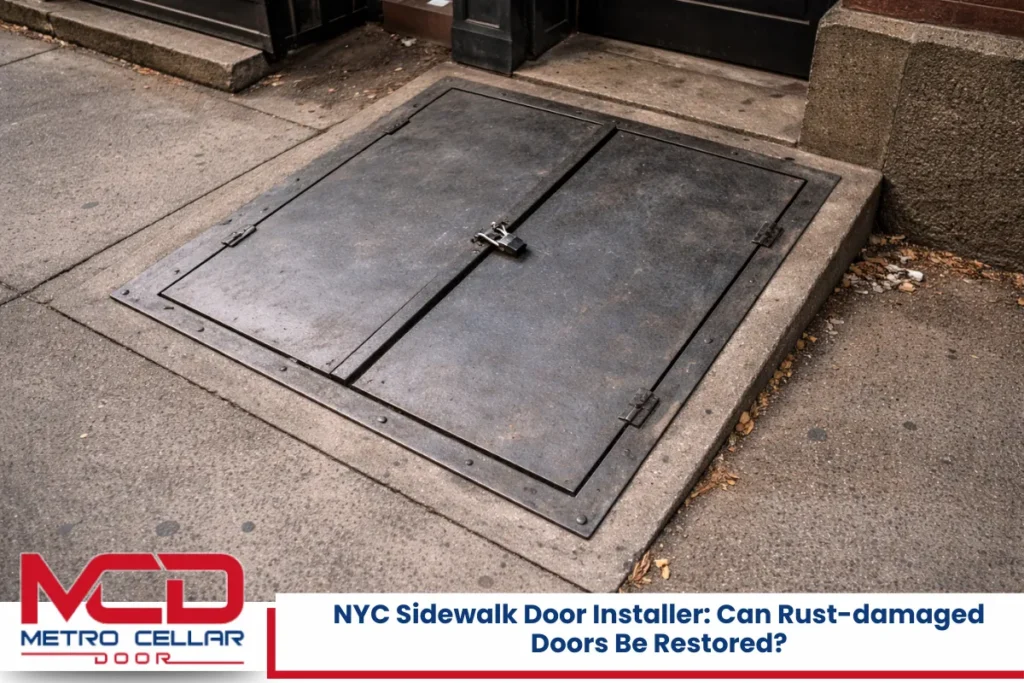
An outward-opening door also has an operating reality in NYC weather. FDNY rules require required means of egress to remain unobstructed and free of snow and ice, and door hardware on an egress route must stay in good working order. DOT’s sidewalk guide adds another practical warning for property owners: cellar doors that deflect excessively, are not skid-resistant, or are otherwise unsafe can qualify as sidewalk defects. That means maintenance is not optional. A door that sticks after a freeze, becomes slick in winter, or flexes under foot traffic can quickly become a code, liability, and injury problem.
Habitable lower levels bring stricter egress rules
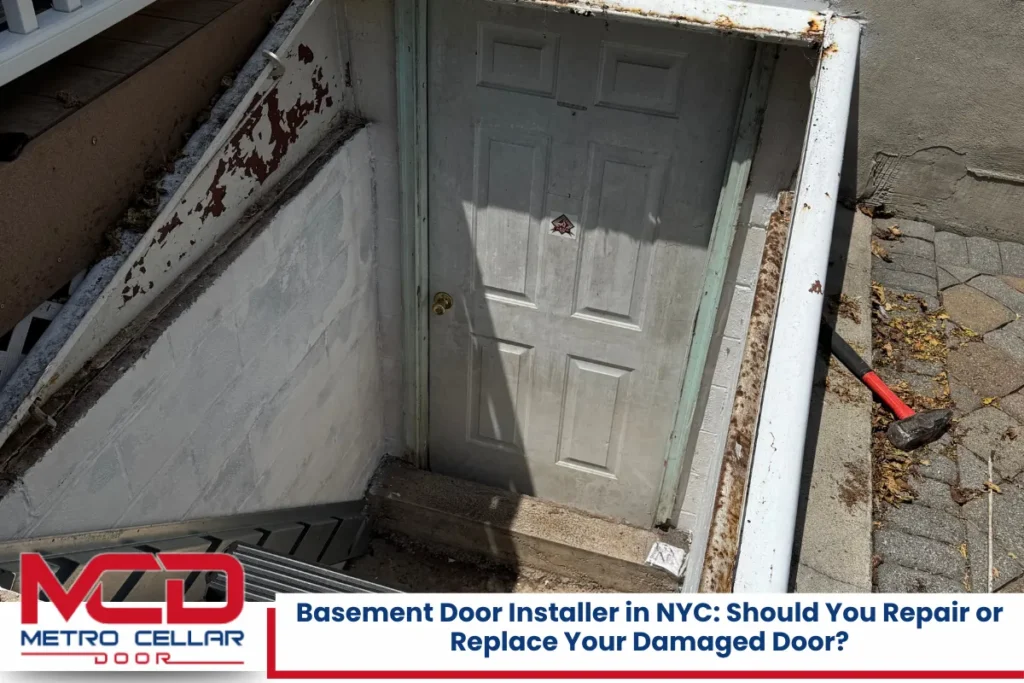
The biggest mistake owners make is assuming the top hatch answers every code question. It does not. HPD warns that basements and cellars cannot be lawfully occupied unless minimum requirements for light, air, sanitation, and egress are met and approved by DOB. DOB guidance for habitable basement apartments requires direct outdoor egress, and current city laws for basement and cellar ADUs require more: emergency escape and rescue openings, landings, and in many cases specific outward access arrangements. In those ADU provisions, the required exterior egress door itself must swing inward and have landings on both sides, even if an upper bulkhead assembly above it opens outward.
The NYC permit and compliance checkpoints owners should clear first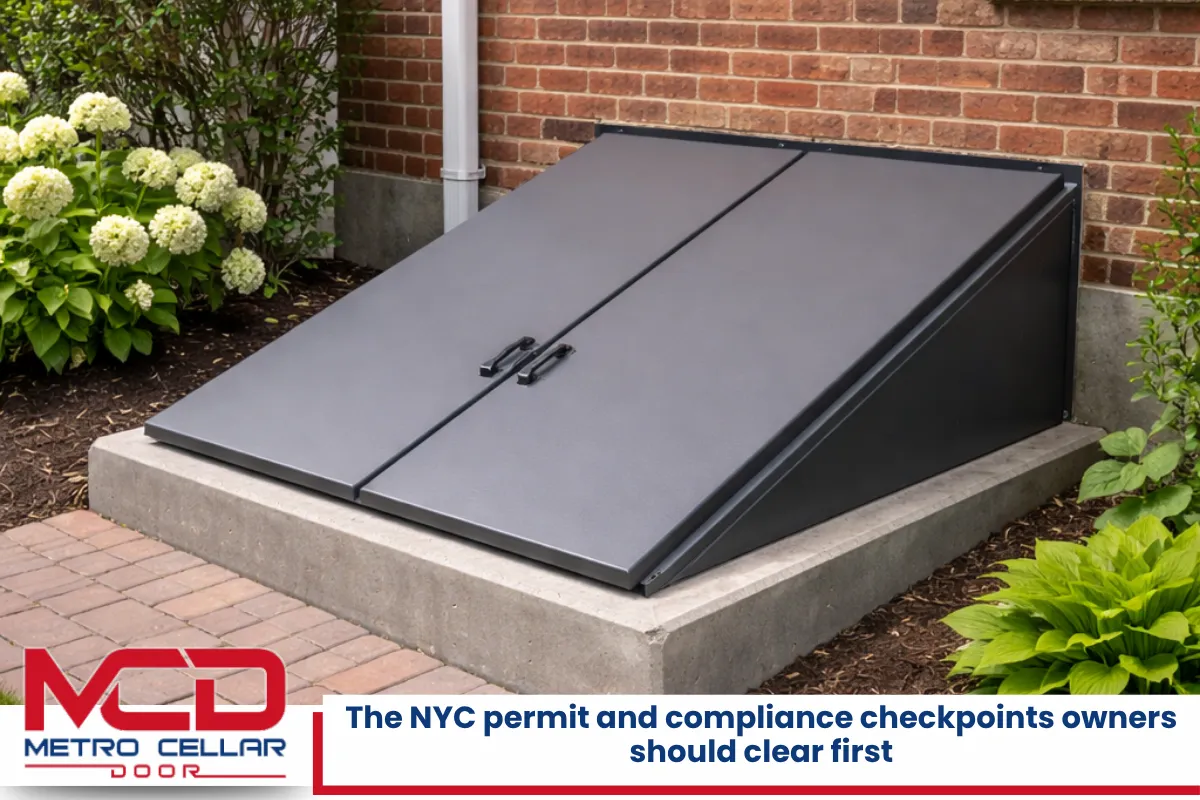
DOB review is the default assumption, not the exception
The safest starting point is to assume the project needs review until a qualified professional says otherwise. DOB states that most construction in New York City requires approval and permits, and that the majority of construction work requires a Department of Buildings permit. That matters for cellar door installation because replacing a door in kind is one thing; changing the opening, rebuilding the areaway, altering structure, affecting egress, or modifying sidewalk conditions is another. A knowledgeable cellar door installer should be able to flag when a simple replacement has turned into a filed alteration.
DOT, drainage, and landmark review can add a second layer
Projects that touch the public sidewalk have a second agency in the picture. DOT says drainage across the public right-of-way is not allowed, and it gives specific design standards for flush, slip-resistant cellar doors at the building line. NYC311 also notes that new sidewalk cellar doors need DOT revocable consent. On landmarked properties and in historic districts, review can go beyond DOB and DOT; DOT’s vault rules require LPC approval before work on vaults in historic districts begins, and NYC’s property owner guide notes that private sidewalk work in landmark districts may also require a Landmarks permit.
The installer should be licensed for the type of property involved
For residential properties, New York City does not treat contractor licensing as a casual detail. DCWP and DOB both state that a Home Improvement Contractor license is required for construction, repair, replacement, remodeling, or related improvement work on residential land or buildings, including basements and adjacent structures. DOB also notes that where a permit requires HIC licensing, the license number must be supplied in the permit paperwork. That makes “licensed and insured” more than a sales phrase. It is part of the hiring checklist.
Matching the door style to the property instead of forcing one solution everywhere
Brownstones, row houses, and private stair areaways
If your opening is in a private front areaway, side yard, or rear stairwell, an outward-opening bulkhead often makes the most sense. The design keeps the door leaves above the stair rather than intruding into the lower-level path, and it usually offers better carrying clearance for boilers, laundry equipment, renovation debris, and storage. The key question is not whether outward-opening is trendy. It is whether the stair geometry, wall conditions, drainage pattern, and available swing space support it without creating a water trap or an awkward pinch point.
Mixed-use buildings and storefront basements
For storefronts and commercial basements with street-level access, the answer usually shifts. A flush sidewalk door or flat steel hatch is often more compatible with the public realm because it avoids projecting into the walking path. NYC DOT’s rules reinforce that logic by requiring flush mounting, slip-resistant surfaces, and placement outside the pedestrian access route. In these settings, the better question is not “Should it open outward?” but “Can the assembly stay safe, flush, durable, and compliant under pedestrian loading and daily deliveries?”
Finished lower levels need a systems view, not a door-only view
Where the lower level is finished or being positioned for future legal occupancy, the door choice should be made together with egress, waterproofing, insulation, and interior door planning. Manufacturer instructions for bulkhead systems explicitly call for an interior door at the bottom of the stairs to help prevent heat loss and reduce condensation. That small detail says a lot: cellar doors are not stand-alone products. They are part of an envelope, drainage, and life-safety system.
Read Cellar Door Installer in NYC: Can You Get Custom-Shaped Doors for Tight Spaces?
What professional cellar door installation should include before anyone orders steel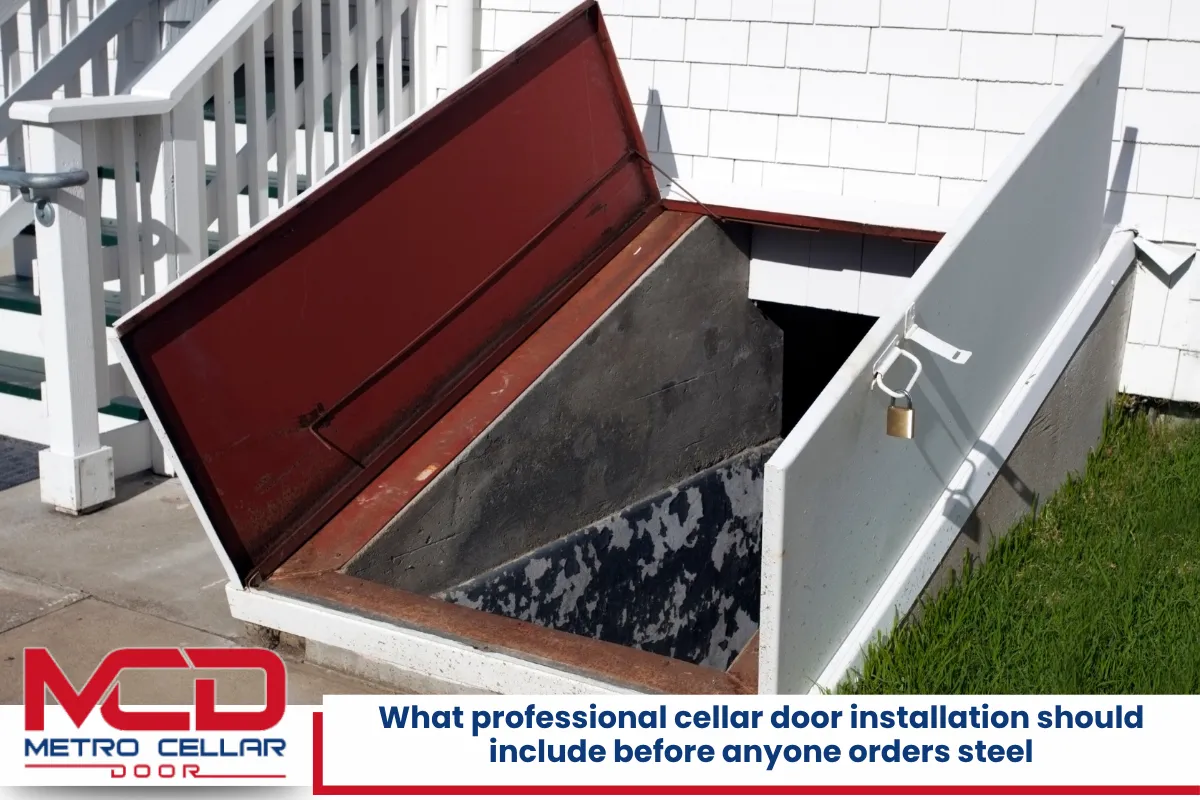
A smart project starts with field conditions, not catalogs. Before a door is fabricated or ordered, a professional should verify all of the following:
- The opening dimensions, diagonal measurements, and wall alignment.
- The condition of the concrete or masonry cap, including cracks, loose material, and uneven bearing surfaces.
- The drainage path around the stair, roof runoff above it, and whether water currently ponds at the sill.
- Whether the location is private property, a sidewalk opening, a vault-related condition, or a landmarked site.
- Whether the space below is simple storage, commercial use, or a legally occupied lower-level dwelling.
- The hardware plan, including lift assistance, lock type, slip resistance, weather sealing, and safe operation in winter.
That kind of front-end review prevents the most expensive mistakes in cellar door installation. Manufacturer guidance is very clear that doors do not shed water properly when the areaway is out of level, the header seams are not caulked, or the assembly sits too low relative to surrounding grade. NYC rules are just as clear that sidewalk assemblies must stay safe for pedestrians and that unsafe or non-skid-resistant cellar doors can become a defect issue. Good installation, in other words, is not just neat welding and new steel. It is fit, slope, clearance, drainage, and compliance all working together.
A quick way to tell if an outward-opening door is probably right
An outward-opening bulkhead is usually the better choice when:
- the opening is fully on private property
- the stairwell has enough swing clearance
- you need a wider path for storage or equipment
- the areaway can be re-capped or leveled properly
- runoff can be diverted and the sill kept above surrounding grade
- the door is not the only life-safety question on a finished or habitable lower level
It is usually the wrong choice when the opening is in the public sidewalk, when the leaves would block pedestrians, when snow and ice regularly trap the swing path, or when an owner is trying to treat a legal egress issue as if it were merely a door-style issue. In those cases, a flush sidewalk assembly, a different stair layout, or a broader DOB-reviewed solution is often the smarter path.
The best swing direction starts with the site, not the catalog
For many NYC properties, an outward-opening cellar door is absolutely the right move. It works well over private exterior stairs, gives you better carrying clearance, and can perform well in bad weather when the masonry, caulking, drainage, and hardware are handled correctly. That is why this style remains a strong solution for many townhomes, brownstones, side-yard stairwells, and rear access points.
But the answer changes fast when the opening touches the sidewalk, the lower level is intended for legal occupancy, or the surrounding conditions make safe operation difficult. In NYC, the “right” door is the one that fits the use of the space, the location of the opening, and the City’s permit and safety rules. If your opening is private, well-drained, and clear of swing conflicts, outward-opening is often the best option. If it is public-facing, pedestrian-exposed, or tied to habitable egress, you need a more code-driven answer before any steel gets fabricated.
Cellar Door Installer in NYC – Metro Cellar Door Bilco Pro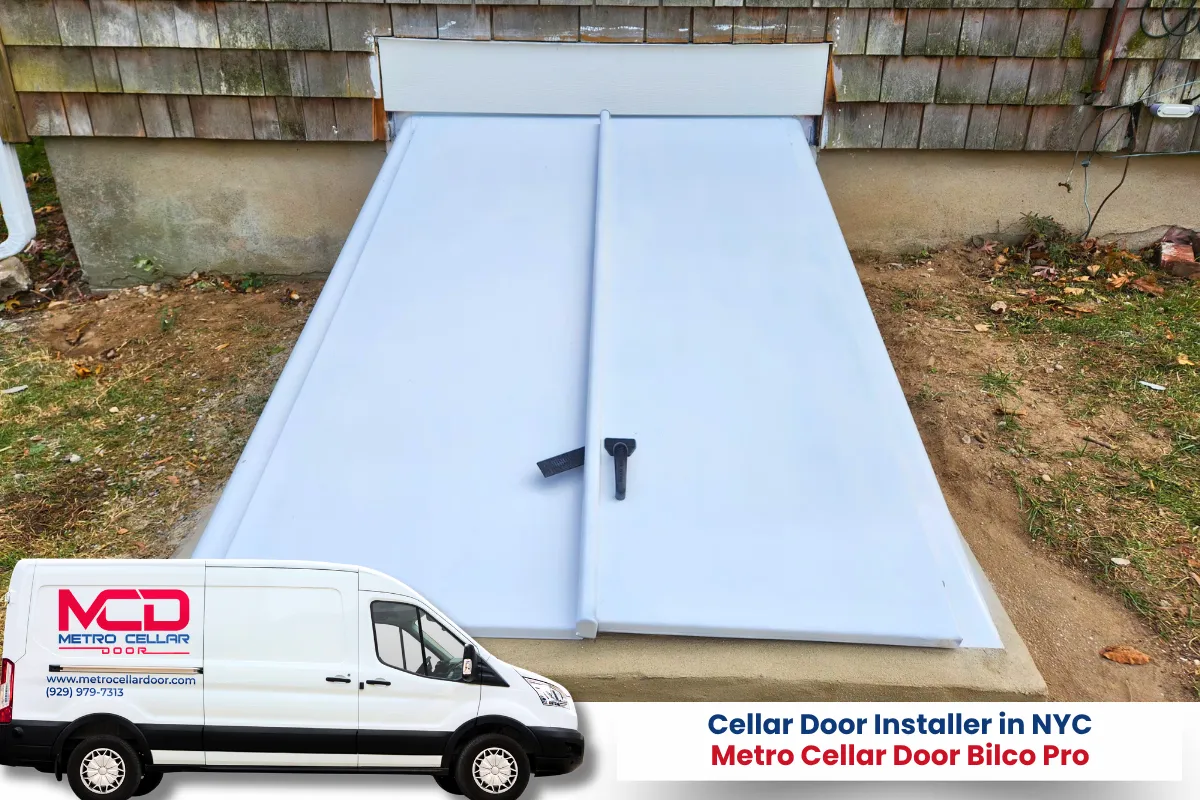
At Metro Cellar Door Bilco Pro, we help property owners choose the right solution instead of guessing. If you need a trusted cellar door installer for a private bulkhead, sidewalk access point, or full cellar door installation, we’re ready to inspect the opening, explain your options, and recommend a safe, durable fit for your property. We serve New York City and the surrounding areas, and we focus on strong workmanship, practical design, and reliable service from start to finish. Call us at (929) 979-7313 to discuss your project, or fill out our contact form to schedule an estimate. When you want cellar doors that work properly, look sharp, and are built for real NYC conditions, Metro Cellar Door Bilco Pro is ready to help.
Frequently Asked Questions
Can I remove my cellar door temporarily while foundation or waterproofing work is being done?
You can, but only if the opening is protected properly and the overall project stays compliant. Once a cellar opening is uncovered, the issue is no longer just convenience. It becomes a safety, access, and weather problem. If the opening touches the sidewalk or public right-of-way, extra care is critical because DOT regulates work in those areas. If the stair serves an occupied space or required egress path, FDNY’s unobstructed egress rules still matter during construction. In practice, temporary removal should be coordinated with the contractor, permit holder, and any design professional so the site remains secure, covered, and safe until the permanent door is installed.
What paperwork should I keep after a cellar door installation is finished?
Keep more than the invoice. For residential work, you should retain the signed contract, change orders, proof of the installer’s DCWP Home Improvement Contractor license, permit information if a DOB permit was required, warranty materials, product specifications, finish or paint instructions, and final payment records. That paperwork matters later if you sell the property, make an insurance claim, need warranty service, or face a question about whether work was authorized and properly completed. For sidewalk-related jobs, also keep DOT approvals and any related drawings. Good records are part of protecting the investment, not just closing out the project
Can I add a keyed lock, alarm, or smart sensor to a cellar door?
Usually yes, but the details matter. Security devices that affect a means of egress are subject to DOB and FDNY oversight, and emergency escape or rescue openings must remain operable from the inside without keys or tools where those rules apply. In plain terms, you can improve security, but you cannot create a trap. A keyed exterior lock, contact alarm, or sensor can be fine on many cellar doors, especially storage-only spaces, but the hardware should never defeat code-required egress or interfere with smooth operation. Before adding bars, specialty locks, or electronic access controls, confirm the lower-level use and make sure the hardware matches that use legally and safely.
What should co-op boards, condo associations, or mixed-use owners verify before approving a replacement?
They should verify who controls the area, which agency approvals may apply, and whether the work affects shared property, the sidewalk, or legal egress. In a co-op or condo, the opening may sit in a limited common area even when one unit uses it most. In a mixed-use building, a cellar door may affect deliveries, tenant access, and sidewalk liability. Owners and boards should confirm insurance, scope of work, permit responsibility, landmark status, maintenance obligations, and whether the installation changes structure, drainage, or public access. That way, the project is reviewed once with the right parties, not delayed later because a door replacement turned into a broader building issue.
How should I budget for maintenance after a new cellar door is installed?
Budget for upkeep from day one, especially in New York City weather. The City places sidewalk safety obligations on property owners, and FDNY requires egress components to stay operational. Manufacturer guidance also shows that finishes, caulking, and drainage details directly affect performance. A practical plan includes periodic inspection of hinges, lift assistance, fasteners, seals, skid-resistant surfaces, paint or coating condition, and water flow around the areaway. Check sooner after heavy rain, freezing weather, or roof-drain issues. If the door came primed rather than factory finished, follow the coating timeline in the product instructions. Regular maintenance is much cheaper than dealing with leaks, rust, or a dangerous sidewalk defect later.
Disclaimer: This article provides general information, not legal, engineering, or permit advice. NYC cellar door requirements can vary by property type, occupancy, landmark status, and whether the work affects the sidewalk or public right-of-way.
Read Basement Door Installer in NYC: 5 Signs It’s Time for a Replacement