
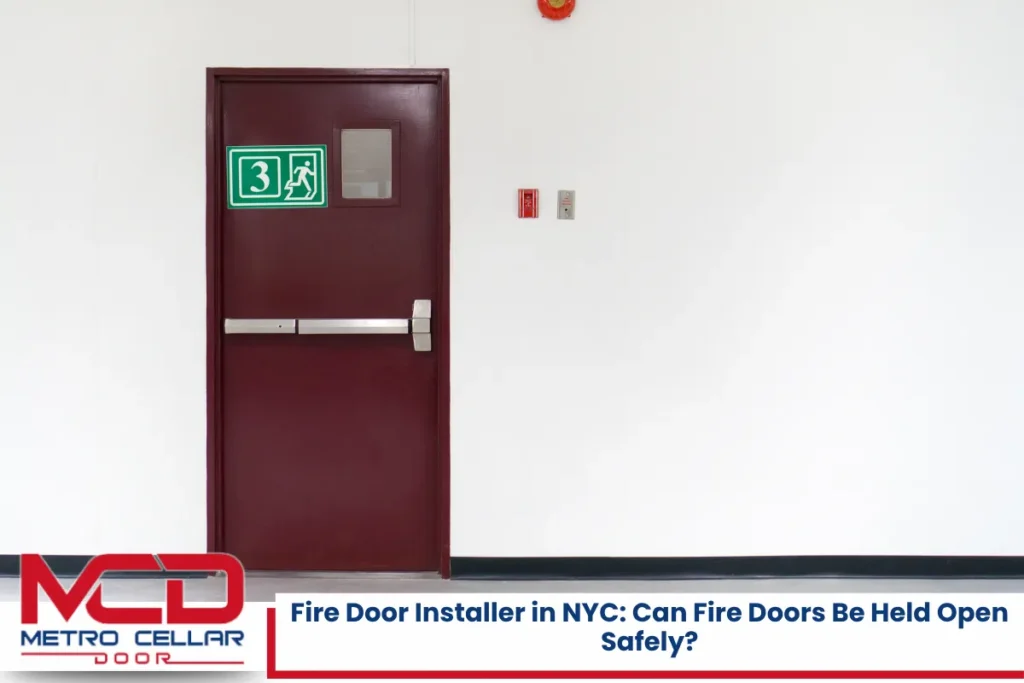
Fire door Installer in NYC professionals get this question constantly: can a fire door be held open without creating a code problem or a life-safety risk? In a city where apartment corridors, stair doors, schools, hospitals, offices, and mixed-use buildings see nonstop traffic, the temptation to prop a heavy door open is real. The trouble is that one wedged-open door can let smoke and heat move fast, undermine compartmentation, and turn an escape path into a hazard. The good news is that some fire doors can be held open safely, but only when the door, hardware, alarm interface, and building conditions are all designed to work together. That is where proper fire door installation, code knowledge, and ongoing testing matter most.
The Direct Answer Property Owners Need
Yes, some fire doors can be held open safely, but not with a wedge, hook, kick-down stop, trash can, or any other improvised method. In New York City, the current Building Code says fire doors must be latching and self- or automatic-closing. NFPA 80 also requires fire doors to be kept closed and latched, or arranged to close automatically during a fire. That means the only acceptable way to keep certain fire doors open is with an approved system that releases the door so it closes when smoke is detected, the fire alarm activates, or another required release condition occurs.
That distinction matters even more in residential buildings. New York City states that apartment and public hallway doors required to be self-closing must swing shut and latch by themselves after opening, and they should never be blocked from closing all the way. When inspectors find defects that prevent a required self-closing door from shutting, sealing, or latching properly, the condition can trigger an immediately hazardous violation.
Why a Propped-Open Fire Door Creates a Bigger Problem Than Most People Think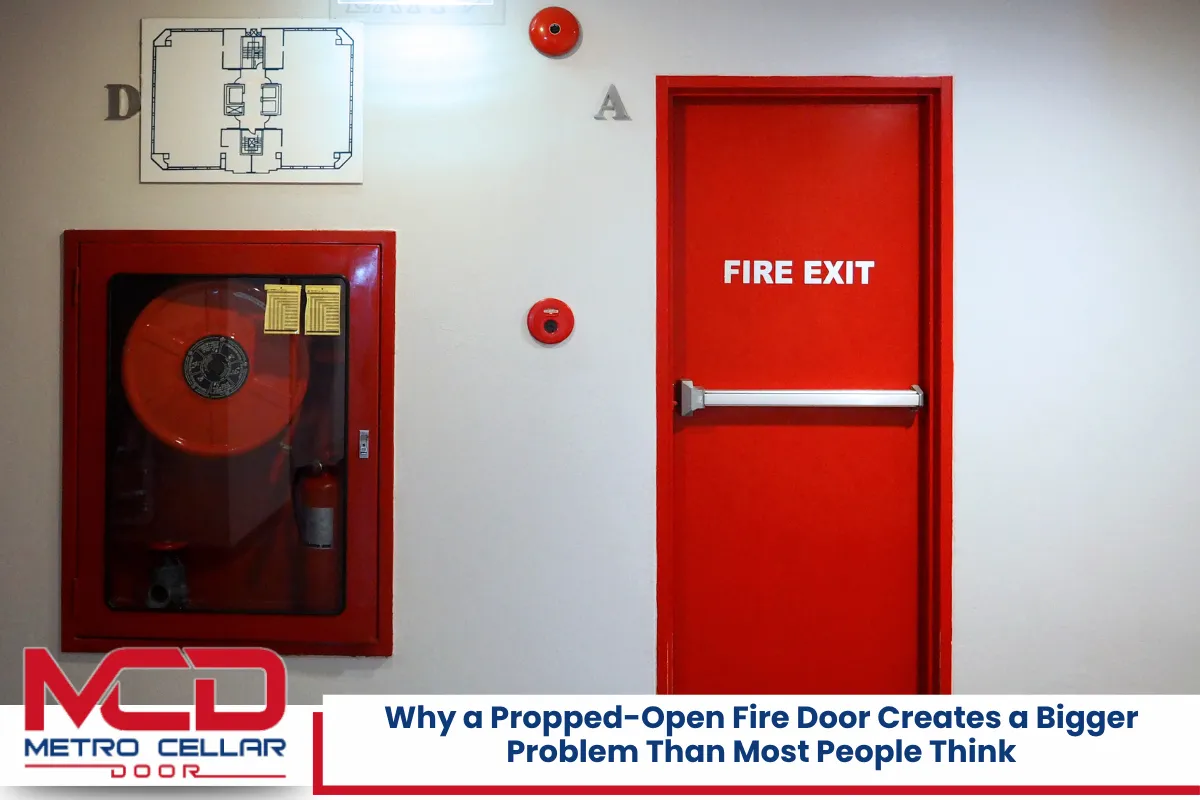
Fire doors are part of a building’s compartmentation strategy. Their job is not only to resist fire for a rated period, but also to limit the movement of smoke and hot gases through corridors, shaft openings, stair enclosures, and other protected paths. Once a fire door is held open by an unapproved object, that barrier is effectively gone. Smoke can spread faster, the closer never does its job, and the latch never engages when it matters most
In practical terms, an open fire door can turn a survivable incident into a much larger emergency. A corridor door that should have stayed shut may feed smoke into an exit route. A stair door that should have protected re-entry or travel between floors may stop performing as intended. In apartment buildings, a door left open can expose neighboring units and hallways to conditions that the self-closing requirement was specifically meant to prevent.
The most common mistake is assuming convenience changes the rule. It does not. A door that feels too heavy, closes too fast, causes traffic backups, or frustrates deliveries is a maintenance or design issue to solve correctly, not a reason to defeat the fire door assembly. That is why experienced fire door installer teams focus on the complete opening, not just the leaf itself.
When Holding Fire Doors Open Can Be Compliant
Approved hold-open use is controlled, not casual
A compliant hold-open setup is usually an automatic-closing arrangement. In simple terms, the fire door is allowed to remain open under normal conditions because a listed hold-open device or closer/holder system is controlling it. When the required release signal occurs, the device lets go and the closer shuts the door so the latch can engage. In NYC, Fire Code provisions require the related hold-open devices, alarm connections, and automatic door closers to be inspected, tested, and maintained, and the annual testing must confirm that the manual release, automatic release, circuitry, and closer all work properly.
This is why the phrase “held open safely” has a narrow meaning. It does not mean “open most of the time.” It means “open only because a compliant system is supervising the door and will reliably restore the fire barrier when needed.” That usually points to magnetic hold-open devices, closer/holder combinations, smoke-detection-based release, and fire alarm integration rather than any mechanical workaround.
Stair and vertical exit doors have tighter limits in NYC
New York City has a specific exception that allows limited use of automatic-closing by smoke detection for doors serving certain vertical exit enclosures, but the allowance is narrow. The law permits no more than one such stair enclosure in a building, the doors may serve no more than three consecutive levels, all those levels must also be served by at least one other exit, and the doors must be connected to a fire alarm system and installed in accordance with the code and NFPA 80. The hold-open devices also need manual release capability, and the wiring connections among the fire alarm system, smoke detection system, and hold-open devices must be electrically supervised.
That is important because many owners hear that “stair doors can be held open now” and assume the rule is broad. It is not. NYC allows limited, conditioned use in certain cases, not blanket permission across all stairs, all buildings, or all occupancies. Any fire door installer working in the city has to review the opening location, occupancy, alarm coverage, sprinkler status where relevant, and egress layout before recommending a hold-open solution.
What Proper Fire Door Installation Has To Get Right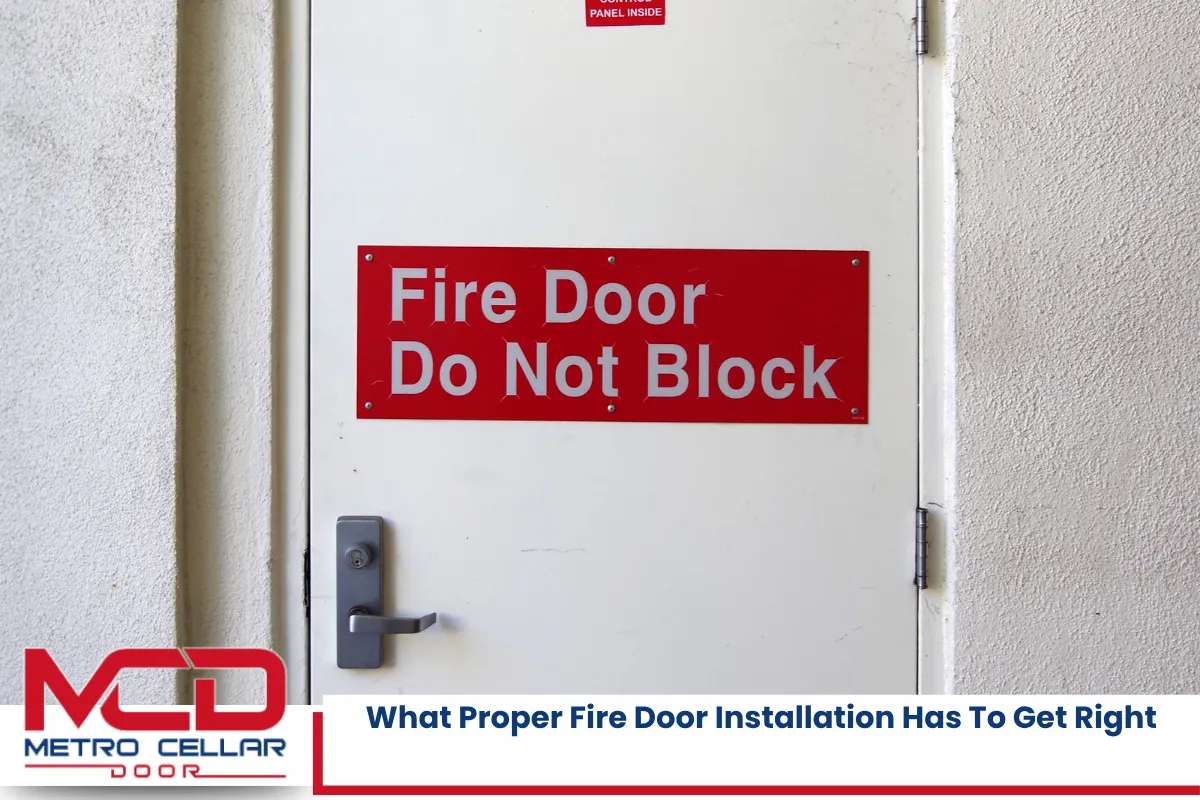
A fire door is an assembly, not just a door slab
One of the biggest misconceptions in fire door installation is thinking the door leaf alone carries the rating. In reality, a fire door assembly is the combination of the door, frame, hardware, and other components working together as an opening protective. That means the closer, hinges, latchset, coordinator where required, glazing, vision panel details, gasketing, smoke seals, astragal, and frame condition can all affect compliance and performance.
This is also why fire door replacement is not a swap-and-go project. The opening has to match the required rating for the wall or enclosure, the components have to be listed or permitted by the manufacturer’s instructions and listing, and the assembly has to close and latch correctly after installation. Even a good-quality door can fail the job if the frame is out of alignment, the latch is mis-set, the closer is underpowered, or the clearance gaps are excessive.
Unapproved field changes can ruin a compliant opening
A lot of fire doors lose compliance after installation, not during it. Someone adds an unapproved deadbolt, drills for new hardware, cuts in a viewer, changes the latch, replaces a closer with the wrong model, or modifies the frame without checking the listing. NFPA 80’s field-modification language is clear that when a field modification to a fire door assembly is desired, the listing laboratory is to be contacted through the manufacturer, and written authorization is required unless the change falls within permitted job-site preparation.
For owners, that means a simple repair request can become a code issue if the person doing the work treats the opening like an ordinary door. For contractors, it means the safe approach is to verify the label, listing, manufacturer instructions, and allowed preparation before cutting, drilling, or substituting hardware. That is especially true in older NYC buildings where openings have been modified multiple times over decades.
Testing and documentation matter after the install
Compliance does not end when the screws are tightened. NFPA 80 requires inspection and testing immediately after initial installation and then at least annually. NYC Fire Code also requires records and on-site instructions for fire alarm systems, including a record of completion verifying installation in accordance with approved documents, plus inspection, testing, operation, maintenance instructions, and as-built design information kept on site at an approved location.
That paperwork becomes especially important when the fire doors are tied to hold-open devices, smoke detectors, or the fire alarm panel. Without proper documentation, it becomes harder to prove what was installed, harder to maintain the system, and harder to troubleshoot why a door failed to release, close, or latch.
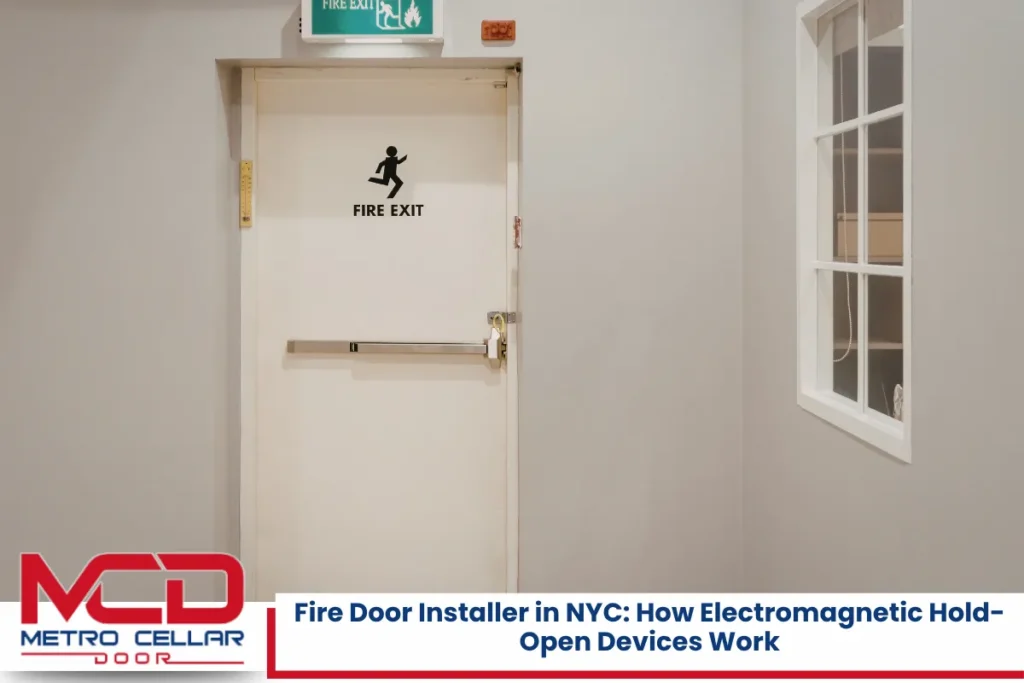
Read Fire Door Installer in NYC: How Electromagnetic Hold-Open Devices Work
The Trouble Spots That Cause Fire Door Failures in NYC Buildings
In the field, the same issues show up again and again:
- wedges, kick-down holders, chains, or makeshift stops holding the door open
- closers that are disconnected, leaking, badly adjusted, or too weak to close the door fully
- doors dragging on the floor or frame because of settlement, wear, or poor alignment
- latches that do not engage consistently
- excessive clearance gaps that weaken smoke and fire protection performance
- hardware changes that do not match the listing or manufacturer requirements
- missing, damaged, or illegible labels that make verification harder during inspection
These are not small details. A fire door can look fine during day-to-day use and still fail the exact moment it is needed. That is why building staff should physically test doors instead of assuming. NYC housing guidance even tells owners and tenants to check whether the door swings fully shut, closes completely, and latches, and to look for obstructions or devices capable of holding it open.
How Owners and Managers Should Make the Right Call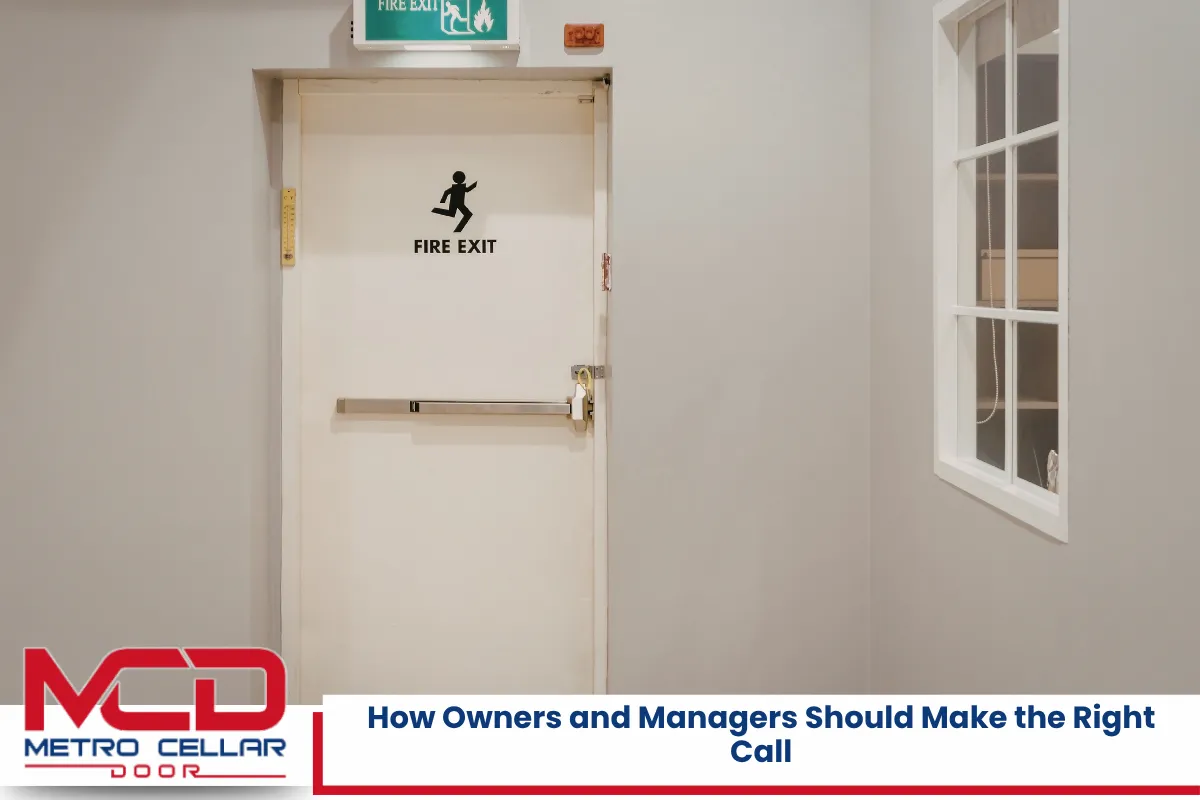
If a fire door is constantly being propped open, the smartest response is not enforcement alone. It is diagnosis. Ask why people keep doing it. Is the closer too aggressive? Is the door in a high-traffic corridor? Is there a delivery route, accessibility issue, or operational bottleneck? Is the opening in a location where code may allow an automatic hold-open system? Or is it a door that must simply remain self-closing at all times?
A practical review should cover these points:
- Is the opening actually part of a rated wall, corridor, shaft, stair, or other protected enclosure?
- Does the code require self-closing, or is automatic-closing by smoke detection permitted here?
- Is there an existing fire alarm or smoke detection system that can lawfully control a hold-open device?
- Will the door fully close and positively latch every time the device releases?
- Has the assembly been installed, documented, inspected, and tested in a way the building can maintain?
Owners also need to remember that permitting and filing obligations may apply. NYC states that most construction requires approval and permits from the Department of Buildings, and code text also shows that work affecting fire-rated partitions or enclosures can require separate filings. In other words, changes around a rated opening should never be treated casually.
What Safe Hold-Open Use Really Comes Down To
In New York City, the safest rule is simple: never prop open a required fire door with an improvised object. If a door needs to stay open for traffic flow, accessibility, or operations, the solution must be a code-compliant automatic-closing arrangement designed for that specific opening. The door still has to release properly, close fully, latch securely, and remain part of a listed fire door assembly. In some locations, especially residential doors and many protected egress openings, the right answer is not a hold-open device at all. It is repairing the closer, adjusting the hardware, or keeping the door shut as required. A knowledgeable fire door installer does more than hang a slab. They protect the opening, the egress path, and the building’s ability to contain fire and smoke when seconds matter most.
Fire Door Installer in NYC – Metro fire Door Bilco Pro
At Metro fire Door Bilco Pro, we help property owners, managers, and contractors handle fire doors the right way. If you need a dependable fire door installer in New York City, we are here to evaluate the opening, explain your options clearly, and help you move forward with code-focused service. We work throughout New York City and the surrounding areas, and we understand how important proper fire door installation is for safety, compliance, and day-to-day use. Whether you are dealing with a door that will not latch, a closer issue, or questions about holding a fire door open safely, contact us today. Call (929) 979-7313 or fill out our contact form so we can help protect your property.
Frequently Asked Questions
Can a fire door be painted after installation?
Yes, but it has to be approached carefully. Fire door labels are critical for identification, and NFPA guidance says painted labels may remain acceptable if they are still readily visible and legible. The bigger issue is not the paint itself, but whether the work hides the rating information, interferes with the door’s operation, blocks glazing, adds unapproved cladding, or turns into an unauthorized field modification. In practice, owners should treat painting as a finish decision, not a chance to alter the assembly. Before repainting, confirm the label will remain readable and that the finish work will follow the manufacturer’s listing and instructions.
Can electronic access control be added to a fire door?
Sometimes, yes, but it is never a hardware-only decision. Once access control is added, the opening must still satisfy egress, fire alarm, and door-closing requirements. NFPA material on locking arrangements emphasizes that life safety codes are aimed at preventing people from being trapped during a fire, and NYC code provisions for alarm-connected door systems show how closely release functions are tied to fire alarm performance. On a rated opening, the door must still become safe in an emergency, which may include unlocking, releasing, closing, and latching depending on the application. That is why access control should be designed as part of the opening, not added as an afterthought.
What records should a building owner ask for after fire door work is completed?
Owners should ask for more than an invoice. For work involving alarm-connected hold-open systems or other fire protection interfaces, NYC Fire Code requires a record of completion verifying the system was installed in accordance with approved design and installation documents. The code also requires inspection, testing, operation, and maintenance instructions, along with as-built design and installation information, to be provided on site at an approved location. Even when the work is limited to a door repair or closer replacement, it is smart to request the scope of work, hardware information, any applicable listing details, and confirmation that the assembly was tested for closing and latching after the work.
Can you replace only the closer, hinges, or latch instead of replacing the whole fire door?
In many cases, yes, but only when the replacement parts are compatible with the listed assembly and the work stays within what the manufacturer and listing allow. A fire door is a system, so swapping one component can affect the whole opening. NFPA 80’s field-modification provisions make clear that changes outside permitted job-site preparation may require written authorization through the manufacturer and listing laboratory. That means a closer replacement can be routine, or it can become a compliance issue if the new hardware changes mounting locations, fastener patterns, door preparation, or performance. When in doubt, verify first and replace second.
How can an older NYC building verify a fire door rating if the label is missing or hard to read?
Older buildings often create this problem, especially after years of repainting, hardware changes, and repairs. NFPA material indicates that painted labels may remain acceptable if still legible, and it also recognizes that fire ratings of existing doors and frames may sometimes be verified through approved inspection services or other means, such as construction documents, door schedules, shop drawings, finish hardware schedules, catalog information, production codes, or identical labeled openings elsewhere in the building. The key point is not to guess. A qualified professional should verify the rating through acceptable documentation or inspection methods before the owner relies on that opening as compliant.
Disclaimer: This article provides general fire-safety information, not project-specific legal or code advice. Fire door requirements can vary by occupancy, building conditions, and scope of work in New York City.
Read Cellar Door Installer in NYC: Can You Get Custom-Shaped Doors for Tight Spaces?