
NFPA 80 and NYC Fire Door Inspections: Why They Matter Right Now
Every fire door in your building stands between your occupants and a life-threatening event. Yet across New York City, thousands of fire rated doors quietly fail NFPA 80 requirements every year because of worn closers, oversized gaps, missing seals, or labels that have been painted over. The consequences are not theoretical. After the 2022 Twin Parks fire in the Bronx, which killed 17 people and was worsened by doors that failed to close, HPD issued over 30,000 self-closing door violations citywide that same fiscal year and nearly 50,000 the following year. Buildings face rapid smoke spread, blocked emergency exits, costly violations, insurance complications, and serious liability exposure. Understanding exactly what NFPA 80 requires for fire door inspection in NYC empowers building owners to schedule proper annual checks, fix deficiencies promptly, and plan compliant fire door installation when replacement is the only path forward.
Key Takeaways
- NFPA 80 requires every fire door assembly to be inspected at installation and at least annually thereafter in NYC buildings with fire rated assemblies.
- Inspections must be performed by qualified personnel who understand NFPA 80, the NYC Building Code, and FDNY enforcement expectations.
- Each fire door inspection covers a checklist of at least 13 specific items, including labels, clearances, self closing devices, hardware operation, and overall condition, all of which must be documented in writing.
- NYC agencies such as FDNY, DOB, and HPD actively issue violations when fire doors are blocked, damaged, unlabeled, or not self closing and latching correctly, with fines starting at $1,000.
- When inspections reveal noncompliant assemblies, property owners should coordinate with a knowledgeable fire door installer to plan compliant replacements rather than attempting unauthorized field repairs.
How NFPA 80 Fits Into the NYC Fire Door Code Framework
NFPA 80, formally titled the Standard for Fire Doors and Other Opening Protectives, is the primary national standard governing the inspection, testing, maintenance, and installation of fire door assemblies. The NYC Fire Code enforces NFPA 80 standards locally by incorporating them by reference, which means every provision in the standard carries the force of law within the five boroughs.
Here is how NFPA 80 interacts with the broader regulatory structure in New York:
- The NYC Building Code, specifically BC Chapter 7, establishes fire resistance requirements for walls, barriers, and the opening protectives installed within them.
- FDNY rules address means of egress, fire protection systems, and the operation of doors along exit pathways, including emergency and security hardware.
- The NYC Housing Maintenance Code requires self closing doors in multifamily housing, reinforced by Local Law 111 of 2018, which made failure to maintain these doors an immediately hazardous violation.
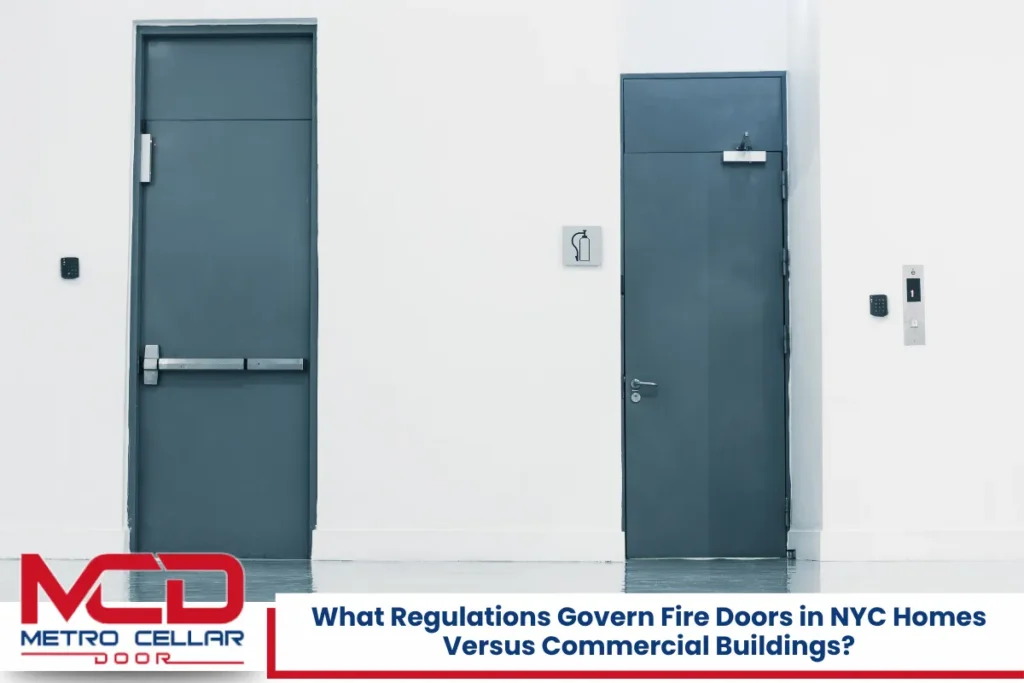
NFPA 80 applies to swinging, sliding, rolling, and overhead fire doors, as well as the frames, glazing, and hardware that form part of a fire rated assembly. New York City’s adoption of modern code editions means building owners must treat NFPA 80 inspection provisions as enforceable mandates, not optional best practices. Authorities having jurisdiction in NYC include DOB plan examiners, FDNY inspectors, and HPD inspectors for residential self closing doors in apartments.
Inspection Frequency: How Often Fire Doors Must Be Checked in NYC
NFPA 80 requires annual fire door inspections as the baseline for every rated assembly. Fire doors must also be inspected immediately after installation to confirm that the assembly was completed correctly and performs as intended.
Beyond the annual cycle, NFPA 80 requires inspection after any repair, modification, or field preparation that could affect the door’s fire rated performance. Replacing hardware, altering a frame, or adjusting a closer all trigger the need for a post-work check. In practice, many NYC property managers align their annual fire door inspection with other building compliance cycles, such as FDNY inspections or Local Law safety reviews, for scheduling convenience.
Certain building types with higher life safety risk, including hospitals, high-rise residential towers, and large assembly spaces, often perform inspections more frequently as a best practice even though NFPA 80 sets a minimum of once per year. Missing the annual inspection interval can lead to compounding violations, steeper penalties, and far more complex remediation when FDNY or DOB discovers multiple years of neglect during a routine visit or after an incident.
Who NFPA 80 Recognizes as Qualified to Inspect Fire Rated Doors
NFPA 80 defines a qualified person as someone with knowledge and understanding of the construction, operation, and maintenance of fire door assemblies and the specific requirements of the standard itself. This is not a casual designation.
In NYC, qualified personnel typically demonstrate their competence through a combination of:
- Formal NFPA 80 training or third-party certification programs
- Manufacturer or industry association training on specific door types and hardware
- Demonstrated familiarity with the NYC Building Code, FDNY expectations, and applicable local laws
- Installers who need FDNY certification and manufacture training to serve in inspection or installation roles
Building owners remain legally responsible for compliance even when they hire a third party to perform the fire door inspection. AHJs in NYC can ask for proof of credentials, training records, or certifications before accepting inspection reports, and they increasingly do so. While a trained fire door installer might also be qualified to inspect, installation and inspection activities should be documented separately to satisfy auditors, inspectors, and insurers reviewing the record.
Read How Often Should a Fire Door Be Inspected in NYC?
The NFPA 80 Fire Door Inspection Checklist: What Must Be Examined
NFPA 80 lays out a detailed, systematic checklist for annual fire door inspection. Inspections must verify 13 specific items per NFPA 80, and NYC expects these checks to be documented for every individual door in a building. The most common types of rated doors you will encounter across NYC buildings include hollow metal, solid-core wood, and glass assemblies, each with slightly different inspection considerations.
Here is what the checklist covers:
- Labels and markings: Every fire rated door and frame must carry a visible, legible label showing the fire protection rating, listing agency, and test standard. Fire door labels must remain legible and not be defaced, painted over, or removed. A missing or unreadable label is one of the fastest ways to fail an inspection.
- Door and frame condition: Fire doors should not have open holes or structural damage, breaks, warping, or rust that compromise the assembly’s fire resistance. The frame must be securely anchored to the surrounding walls.
- Clearances and gaps: Gaps around fire doors should not exceed specific tolerances set by NFPA 80, typically no more than three-eighths of an inch at the sides and top, with undercuts evaluated based on whether smoke seals are present. Excessive gaps allow smoke to spread rapidly between compartments.
- Self closing devices: Self-closing devices must function correctly on fire doors. The door must close fully and latch from any open position without assistance. Closers that are disconnected, blocked, or improperly adjusted are a frequent finding in NYC.
- Latching and hardware: The latch must press into the strike plate and engage positively every time the door closes. No unapproved surface bolts, deadbolts, or kick-down stops should interfere with closing. Exit devices and panic bars on egress doors must operate per their listing.
- Glazing and vision panels: Fire-rated glass doors and vision panels must use rated glazing in listed frames, with intact markings. Cracked or substituted non-rated glass is a violation.
- Coordinator and astragal devices on pairs: For double-leaf doors, coordinator hardware must ensure both leaves close and latch in proper sequence. A pair that does not coordinate correctly can leave a gap that undermines the assembly.
- Thresholds, seals, and gasketing: Smoke and intumescent seals must be installed where the fire and smoke rating requires them. Worn, missing, or damaged seals compromise protection.
- Field modifications: Field modifications that compromise fire doors are prohibited. Any jobsite alterations, such as drilling, cutting, or adding non-listed hardware, must fall within the listing limitations or be reviewed and approved by the listing agency.
- Operation test: The door must close from the fully open position and latch securely without binding on the frame, floor, or threshold.
Blocking fire doors open violates required operation features under both NFPA 80 and NYC codes. Real-world NYC issues include door closers removed by tenants, doorstops wedged into corridors, and non-rated replacement hardware installed by building maintenance teams who may not understand listing requirements. Any deficiency discovered during inspection must be addressed promptly, often within time frames set by NYC enforcement notices.
Documentation, Records, and What NYC Inspectors Expect to See
NFPA 80 requires written records of every fire door inspection, and NYC agencies frequently ask to see them during audits, complaint investigations, or after a fire. Inspection records must be maintained and available for review at all times. Qualified installers and inspectors must provide documentation for materials and labor associated with any work on rated assemblies.
A compliant inspection record should include:
- Inspection date and type (initial, annual, or post-repair)
- Building name, address, and specific location or identification number for each fire rated door inspected
- Name and credentials of the person who completed the inspection
- Checklist results for each of the required items, noting pass or fail
- Description of any deficiencies found
- Date and method of corrective actions, including whether a new fire rated door was installed as a replacement
Records should be retained for at least three to five years so that DOB, FDNY, HPD, or insurance carriers can verify continued compliance. Standardizing the documentation format across all building types in a portfolio makes audits far more manageable. Digital recordkeeping and photo documentation of each fire door assembly is increasingly expected in NYC, particularly for larger residential and commercial properties where hundreds of doors must be tracked.
NYC-Specific Rules on Self-Closing Doors and the Building Types Most Impacted
NYC codes require fire doors to be self-closing and self-latching in nearly every rated opening. Local Law 111 of 2018 specifically mandates that in multiple dwellings, doors opening into corridors or stairs must close and latch on their own. The compliance deadline passed in 2021, and enforcement has been aggressive since.
NFPA 80 inspection must verify that door closers are installed and operational, that doors close from the fully open position without assistance, and that they latch securely every time without binding. In the event of a failure, HPD classifies it as a Class C immediately hazardous violation with a 21-day correction window. Failure to inspect fire doors can result in fines starting at $1,000, and repeat violations press the total cost much higher.
The building types where NFPA 80 fire door inspections are most prominent in NYC include:
- Apartment buildings with three or more units, where corridor and stairwell doors protect lives daily
- Mixed-use and commercial office buildings with fire barriers separating occupancies
- Hotels and large residential occupancies across all five boroughs
- Schools, hospitals, and institutional buildings where occupants may need assistance during an emergency
- Industrial buildings with fire rated doors protecting hazardous areas
Solid-core wood fire doors are often used in residential spaces, while hollow metal fire doors are used in commercial and industrial settings. Each must accommodate the specific fire rating and hardware requirements of the opening where it is installed.
Labeling, Fire Ratings, and Matching Doors to the Wall Assembly
Every fire rated door, frame, and certain glazing components must bear an approved label showing the fire protection rating and listing agency. Fire doors must have a fire-resistance rating certified by testing laboratories, and that rating must match the requirements of the barrier in which the door is installed.
Labels must show:
- The manufacture name or brand
- The listing or certification agency mark
- The fire protection rating in minutes or hours
- The test standard designation, and, where applicable, temperature rise information
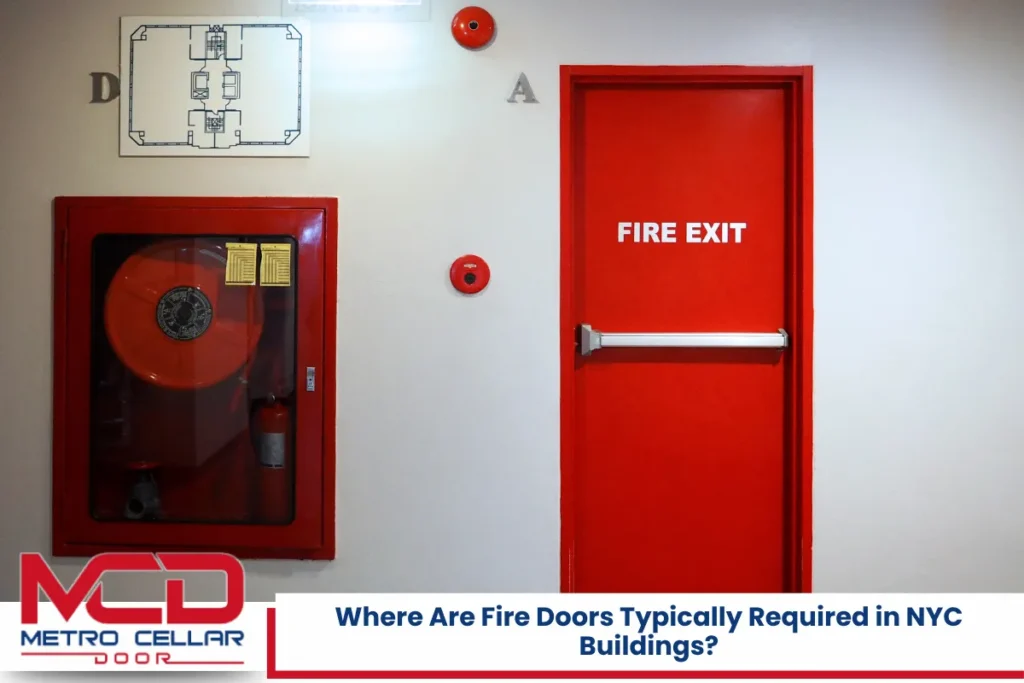
Fire doors can have fire-resistance ratings of 20 to 90 minutes. For example, the NYC Building Code typically requires 90-minute doors in 2-hour stair enclosures and 20-minute doors in certain 1-hour corridor walls. Painting over or removing labels is a common violation and should be avoided at all cost, because an unlabeled door in a rated wall is a red flag during any inspection and almost always requires replacement rather than a simple fix.
When installing doors as replacements, a qualified fire door installer evaluates the existing wall rating, verifies the correct door rating, and ensures that the new assembly, including frame, hardware, hinges, and seals, matches the listing. Only certified installers can legally handle fire-rated door installations in NYC. Fire-rated doors typically cost $200 to $500 more for hardware than standard doors, and the fire door installation costs in NYC range from $1,500 to $3,000 depending on the scope, with labor costs running 15% to 30% above national averages.
Addressing Deficiencies: Repair, Replacement, and Coordination with Installers
NFPA 80 treats deficiencies found during fire door inspection as critical life safety issues requiring prompt correction, not deferred maintenance. The distinction between door repair and full replacement depends on the severity of the problem.
Minor field repairs are acceptable when they involve adjusting closers, replacing listed hinges with identical components, or correcting small hardware issues. Full fire rated door replacement is usually needed when:
- The door has no label or the label is unreadable
- The frame has major structural damage
- Gaps exceed listing tolerances and cannot be corrected within the existing assembly
- Unauthorized field modifications have been made
Fire door installations require precise measurements and approved materials. Structural framing for non-standard openings can add $300 to $800 to a project, and permit fees for fire door installation in NYC range from $150 to $600. Installers must be familiar with NYC fire safety regulations to ensure the completed work will pass inspection.
Building owners should coordinate with a qualified fire door installer in New York by:
- Reviewing the NFPA 80 inspection report to identify which doors failed inspections
- Prioritizing high-risk deficiencies in stairwell doors, egress corridors, and protected openings
- Planning phased replacements to manage cost across a large property portfolio
- Scheduling work to accommodate tenant needs and minimize disruption to building operation
After a new fire rated door is installed, NFPA 80 requires a fresh inspection and operational test to confirm compliance. This should be documented as part of the project close-out, giving the building owner proof that every assembly is secure and code-ready. That documentation provides peace of mind and a strong defense in the event of future audits or legal scrutiny.
NYC Fire Door Installer – Metro Cellar Door Bilco Pro
At Metro Cellar Door Bilco Pro, we serve New York City as a specialized fire door installer focused exclusively on installation and replacement of code-compliant fire rated doors. We do not perform repairs. When your NFPA 80 inspection reveals that doors or frames must be upgraded, our team steps in with the expertise to get it done right. We are familiar with NYC Building Code and DOB requirements, and we coordinate directly with building owners, property managers, and inspectors to ensure every new installation is inspection-ready from day one. Whether your project involves stairwell doors, corridor doors, or exterior-rated egress openings in residential or commercial properties, we are here to help. We also serve Long Island and surrounding areas. Call us at (929) 979-7313 or fill out our contact form to get started.
Frequently Asked Questions
Do I Need an NFPA 80 Fire Door Inspection If I Only Have a Few Rated Doors in My Small Building?
Yes. NFPA 80 does not include an exemption based on the number of rated doors in a building. Even a small NYC building with just two or three fire rated doors in stairwells or corridors must have those assemblies inspected annually by qualified personnel. HPD and FDNY enforce these requirements across all building sizes. A single noncompliant door in a smaller building can be just as dangerous as dozens of failed doors in a high-rise, because smoke and fire do not discriminate by building size. Schedule your annual inspection regardless of how many doors you have, and keep written records for every assembly that was inspected.
How Can I Tell If a Door in My NYC Building Is Actually Fire Rated or Just a Solid-Core Door?
The most reliable indicator is the label. A fire rated door will have a metal or adhesive label on the hinge edge showing the listing agency, fire protection rating, and test standard. A standard solid-core door may look and feel similar but will not carry this label. If the label is missing, painted over, or unreadable, you cannot assume the door is rated. In that situation, the door typically needs to be replaced with a properly labeled assembly. A certified fire door installer can evaluate your existing doors, check for any remaining label evidence, and recommend whether replacement is necessary based on the wall rating and building code requirements in York County or any NYC borough.
What Happens During an FDNY or DOB Visit If My Fire Doors Fail Inspection?
If FDNY or DOB inspectors find noncompliant fire doors during a visit, they will issue violations. The classification depends on severity. A self-closing door that does not close or latch may receive a Class C immediately hazardous violation with a 21-day correction window. More extensive problems, such as multiple unlabeled doors or blocked egress paths, can trigger additional violations and potentially an order to vacate portions of the building until conditions are corrected. Fines accumulate, and repeated violations can attract heightened scrutiny on future inspections. Having current NFPA 80 inspection records and a plan to address deficiencies demonstrates good faith and can sometimes influence how aggressively enforcement proceeds.
Can Tenants or Staff Make Adjustments to Self-Closing Devices Without Violating NFPA 80?
No. Tenants and building staff should not adjust, disable, or remove self-closing devices on fire rated doors. Even well-intentioned changes, such as loosening a closer to make a door easier to open, can compromise the assembly’s ability to close and latch during a fire. NFPA 80 requires that any maintenance or adjustment to fire door hardware be performed by or under the direction of qualified personnel using listed, compatible components. Building management should communicate this clearly to all occupants through posted notices and lease provisions, and should respond quickly when closers are found tampered with or doors are propped open.
How Far in Advance Should I Plan Fire Rated Door Replacements in an Occupied NYC Building?
For occupied buildings, start planning replacements as soon as your annual inspection report identifies doors that cannot be brought into compliance through simple adjustments. Lead times for fire rated doors and frames can range from a few weeks to several months depending on the door type, rating, and whether custom sizing is needed. Permit processing in NYC also adds time, with permit fees ranging from $150 to $600. Coordinate with your fire door installer early to establish a phased schedule that addresses the highest-risk openings first, such as stairwell and corridor doors, while allowing the building to remain operational and accessible for tenants throughout the project.
Disclaimer
Disclaimer: This article provides general information about NFPA 80 and NYC fire door inspection practices. It is not legal or code advice. Building owners should consult applicable laws, the authority having jurisdiction, and qualified professionals for project-specific decisions.
Read What Is a Walkout Basement Door? A Guide for NYC Homeowners